The Quiet Flaw in GTD: Why Your Complete List Makes You Less Effective
There is a particular kind of calm that arrives when you finally write everything down. Every loose thread, every half-promise, every someday. David Allen named that feeling and built a method around…

It is Sunday evening, and you have finally written everything down: every loose thread, every half-made promise, every someday project that has been circling for months. The calm that follows is real, and David Allen built a whole method around it. Getting Things Done is, at heart, a system for emptying the mind onto paper so that nothing gets forgotten, and it works. Millions of people have felt that relief.
Relief and effectiveness are different things, though, and between the capturing and the doing, GTD makes a quiet assumption that does not hold up. It assumes that a complete list is a good list, so that the more faithfully you record the work, the closer you are to doing the work that matters. That assumption is the one thing GTD got wrong, because a list that forgets nothing still cannot tell you what to do.
Why a complete list feels responsible but rarely shows what matters
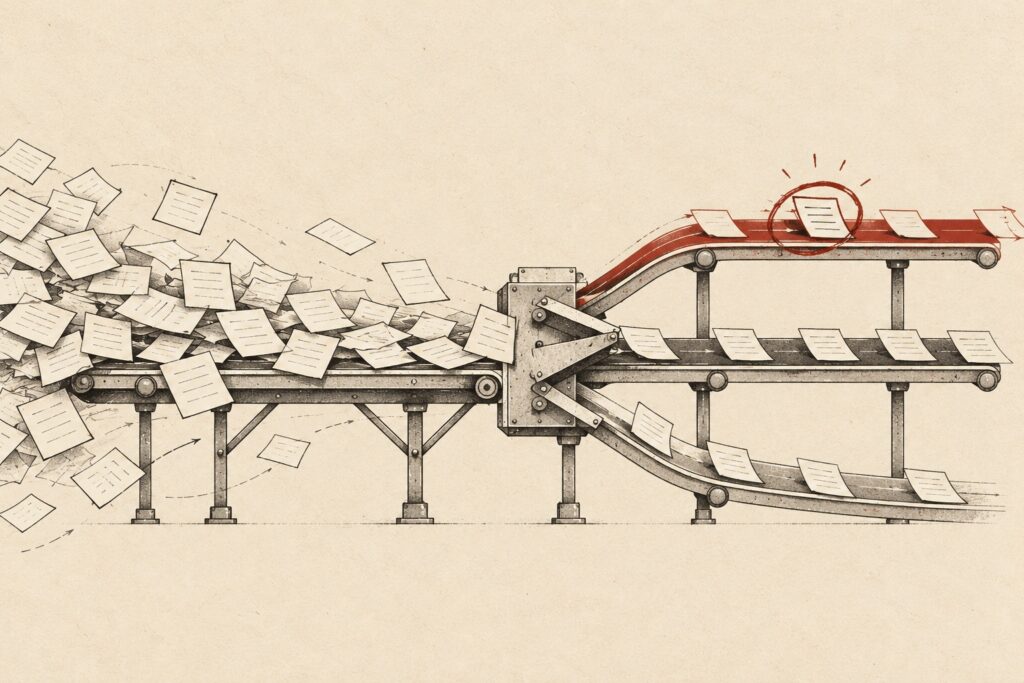
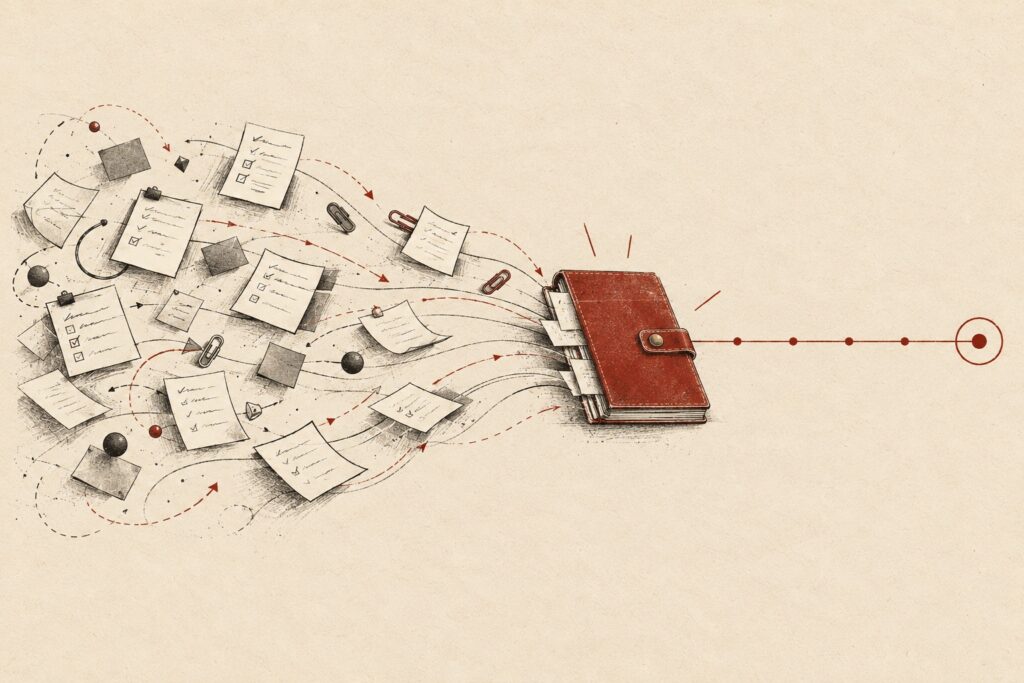
A complete list tells you what exists, and it says almost nothing about what deserves your attention today. Allen’s great insight was diagnostic. He saw that an unrecorded commitment occupies the mind whether or not you act on it, and that the remedy is to get it out of your head and into a trusted system. The instruction is to capture everything first and leave filtering and ranking for later, in a separate step, and in practice that later step is the one people skip.
So the list grows to forty items, then sixty. The next-actions list turns into a ledger of everything you could conceivably do, and the longer it gets, the more it feels like an accurate map of your obligations. It is easy to start treating completeness as evidence of quality. A full list looks responsible, while a short one looks as if you have forgotten something.
But completeness and impact sit on entirely different axes. A list built to forget nothing has no mechanism at all for surfacing what matters most. Those are two separate sorting problems, and GTD solves the first one beautifully while leaving the second to a kind of willpower most of us do not have at nine in the morning. A long list is just a way of not deciding.
How a long list hides the time each task will take
When you do try to choose from a long list, the list itself works against you, because every item on it carries an optimistic guess about how long it will take. Here the research is unusually clear.
In the late 1970s, Daniel Kahneman and Amos Tversky described what they called the planning fallacy, our tendency to underestimate how long our own tasks will take even when past tasks plainly took longer. The bias is stubborn and survives experience. You know, in the abstract, that the report took all week last time, and you still pencil it in for an afternoon.
Now lay that over a sixty-item list. Each entry hides its own hopeful estimate, and sixty of them, written down by someone still enjoying the satisfaction of having captured everything, add up to a plan that was never physically possible. Looking at the list, you see a full but achievable day, with nothing to warn you that you have overcommitted. That is the planning fallacy working quietly in the background, and the more you capture, the more of that optimism you build in. The completeness GTD prizes is exactly what makes the arithmetic of the day go so badly wrong.
Why a long list makes it harder to start anything
The second cost arrives before you have done anything at all, at the moment you look at the list and try to begin.
In a well-known field study, Sheena Iyengar and Mark Lepper set up a tasting stall in a grocery shop. On some days it offered twenty-four varieties of jam, and on others six. The larger display drew more passers-by, as you might expect, but the smaller one sold far more. Faced with two dozen choices, people sampled, hesitated and walked away, while those faced with six were much more likely to choose and buy. Their broader work found a similar pattern elsewhere: once the range of options grows past a certain point, satisfaction and follow-through both tend to fall. Psychologists call this choice overload.
A long to-do list is a jam display you set up for yourself every morning, with each item a jar. Standing in front of forty of them, the natural response is the one the shoppers had, which is to sample a few easy ones, feel the friction, and drift quietly towards the inbox. The abundance that was supposed to leave you prepared leaves you stalled instead. We tend to assume that more options mean more freedom, but past a small number they mostly mean more hesitation.
So the comprehensive list fails twice. It misrepresents your time, and it overwhelms your judgment. It trades on the comfort of having captured everything and then charges you for that comfort in lost action.
How to turn a captured list into a plan for the day
Keep capturing, and then make a separate decision about the day. Allen was right that an unrecorded commitment nags at you, and a single inbox where everything lands is genuinely useful. The mistake is to treat that inbox as if it were already a plan.
A plan is a decision, and a decision leaves things out by definition. Older traditions understood this better than most modern software does. The Ivy Lee method, taught to a steel executive in 1918, asked for six items written the night before, ranked, with the first one started before any other was touched. Gary Keller’s The ONE Thing narrows the question further, asking for the single task that would make everything else easier or unnecessary. Greg McKeown’s Essentialism describes the same discipline as the deliberate, recurring choice to do less but better. All three are systems for deciding, and they assume the capturing has already been done. Capturing is the easy part, and deciding is the work.
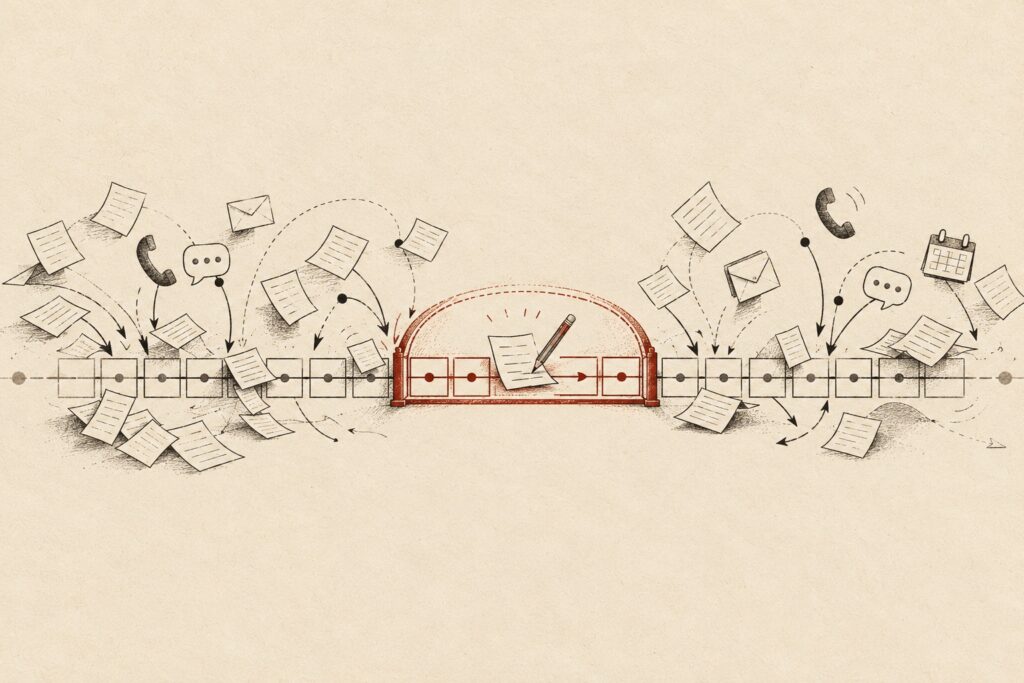
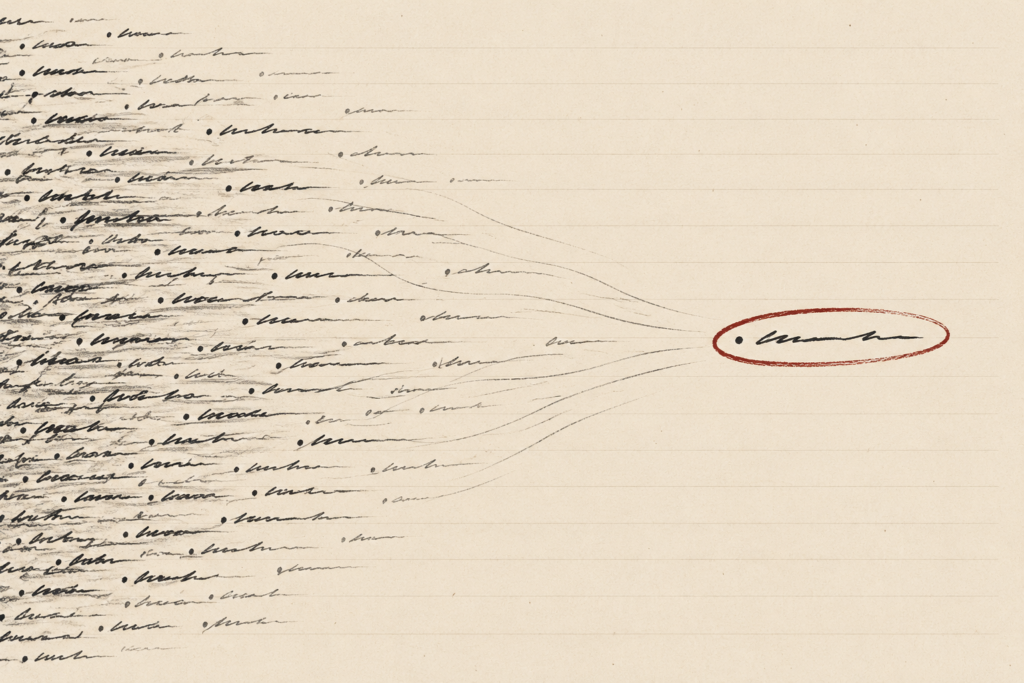
In practice this is almost embarrassingly small. Keep the long list wherever you like; it can hold its forty items without troubling anyone. But the day itself gets one line. You choose the task that matters before the inbox chooses for you, and you let the rest land where it lands. Some of it will slide to tomorrow, as it was always going to, planning fallacy or not. What changes is that the one thing that mattered got done first, while your judgment was still fresh.
A single line enforces something a long list never can, which is that you have to decide. That is also, quite deliberately, the whole idea behind the paper diary we make: a page with room for the day’s one decision, and a firm refusal to give you room for fifty.
GTD asked the right first question, which was how to stop carrying all of this in your head. It simply stopped one question too soon. The harder question, the one that decides whether a day amounts to anything, asks what you will do today, out of everything you could.
Eleven things to do. One that matters.