The Farmer’s Almanac and Planning You Can’t Rush
An almanac plans at the scale of a season because the crop does not care about your quarter. Some work has a rate you can miss but cannot increase.

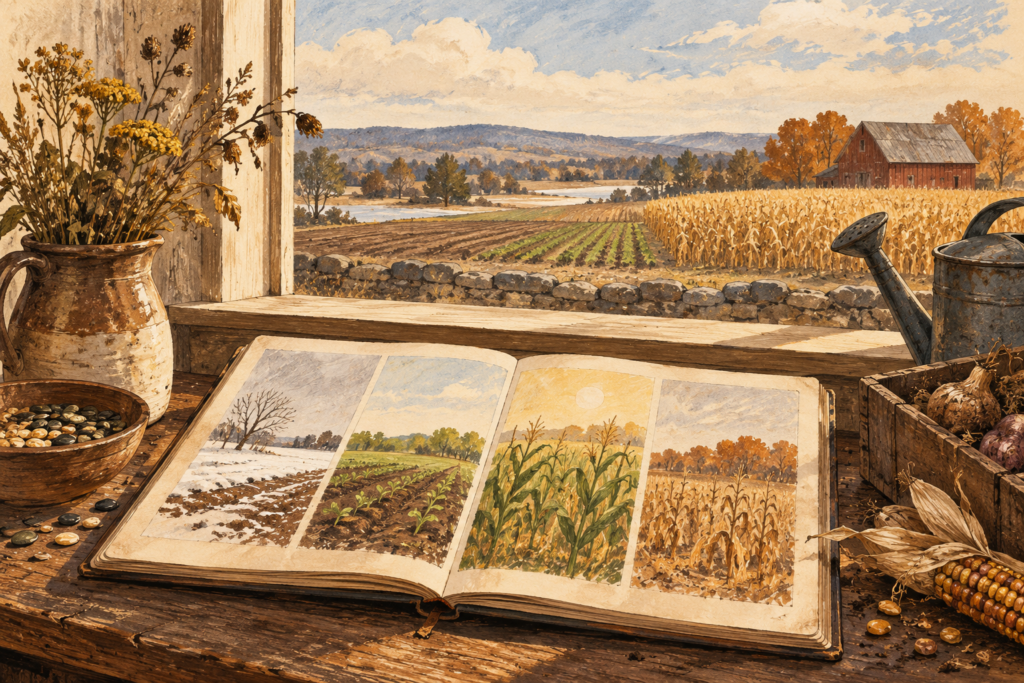
Anyone who has sown a row of beans knows the week or two that follows. You water, you check, and each morning the soil looks exactly as it did the day before. Nothing you do in that time will bring the shoots up sooner, and the only ways to change the outcome are to have prepared the ground properly beforehand or to spoil it now by fussing.
The Old Farmer’s Almanac has been published every year since 1792 and is the oldest continuously published periodical in North America. It holds planting tables, tide charts, astronomical data and weather predictions of disputed accuracy. What makes it worth thinking about for ordinary work is less the forecasting than the unit it plans in. An almanac plans a year at a time because what it is planning runs on that cycle, and no amount of enthusiasm shortens it.
Work that cannot be hurried by extra effort
Some work moves at a fixed pace, and extra effort can slow it down but cannot speed it up.
A crop takes the time it takes. You can miss the planting window, sow badly or neglect the ground, and each of those makes the harvest worse. What you cannot do is make it grow faster by working harder in June.
That imbalance applies well beyond farming. A good deal of ordinary work has the same property: rushing it damages it, and beyond a certain point nothing accelerates it. Learning a skill works this way, as does building a reputation, recovering from a difficult period, or waiting on a decision that genuinely belongs to someone else.
Treating that kind of work as if it responds to intensity produces a familiar disappointment. There is a burst of effort, nothing visibly moves, and the conclusion is that the approach must be wrong, when in fact the approach was sound and the timescale was misjudged.
Making the big decisions once per season
An almanac puts the important decisions at the start of each cycle and leaves the daily work to follow from them.
Those decisions are about preparation, timing and order: what goes in which field, when the ground will be ready, and what must be finished before the first frost. Once they are made, the daily work is no longer strategic. It becomes maintenance and observation at a steady rhythm, and the result depends largely on whether the seasonal choices were sound.
Modern working life tends to reverse this. A great deal of attention goes into making each day more efficient, and very little into deciding what the quarter is actually for, which produces well-run days that point in no particular direction. More daily discipline will not fix that. What helps is a decision made once, at the scale of the cycle, and then left alone, which is what a monthly or seasonal intention does.
Why checking slow work every day misleads you
Judging slow work day by day gives you the feeling of information while telling you almost nothing, and the adjustments it prompts tend to do harm.
Kahneman and Tversky called one version of this the belief in the law of small numbers: people treat small samples as representative and trust what they seem to show far more than they should. For slow work, a single day is about the smallest sample there is. One day of a project that will take a year carries almost no signal about whether it is working.
A farmer who dug up the seed each morning to see how it was doing would ruin the crop and learn nothing. Reviewing a long project every day and adjusting it in response does the same thing in a quieter way. Every change resets whatever was under way, so nothing stays in place long enough for anyone to tell whether it works.
The almanac’s answer is a difference in rhythm: observe daily, judge seasonally, and keep the two activities apart. The same logic is why a week is the shortest unit worth drawing conclusions from for ordinary work, and why anything substantial deserves a quarter.
Why slow work still has deadlines you cannot miss
Slow work still has a few fixed deadlines, and they are less forgiving than the deadlines on fast work.
This matters because the argument is easily misread as a case for drifting along without urgency. Farming is ruthless about timing. Miss the planting window and the year is lost, and no amount of later effort makes up for it. The slowness is exactly what makes those dates absolute, since a quick task can be done again next week while a season cannot be repeated until next year.
So planning you can’t rush still contains urgency. The urgency gathers around a handful of moments instead of being spread evenly across every day, and between those moments the right thing to do is the maintenance.
Knowing which of your commitments have windows like this, and when those windows fall, is most of what seasonal planning involves.
Leaving room for a bad season
Almanac planning assumes that some things will go wrong and leaves room for them from the start.
A late frost, a wet spring or a failed field is treated as normal. A plan with no slack in it is understood to be a plan that will fail in the first ordinary bad season, so the margin is part of the design.
Buehler, Griffin and Ross called the working version of this problem the planning fallacy: people underestimate how long their own tasks will take, even when they know similar tasks have overrun before. Farming has long carried its own correction, which is to plant more than you need, on the assumption that some of it will not come up.
At work, the nearest equivalent is to plan a quarter on the basis of three good weeks a month instead of four. That can look unambitious on paper, but it is a fairly accurate description of how most months turn out.
What an almanac can teach about planning your own work
Three habits carry over from the almanac directly, and a fourth is harder but just as useful.
Plan at the pace the work actually moves. Some work runs on a daily cycle and some on a quarterly one. Planning slow work every week produces constant churn, and planning fast work once a quarter lets it drift.
Keep observing separate from judging. Make a note each day, and draw conclusions at the end of the season. Most of the damage comes from drawing conclusions as often as you observe.
Find the windows. A small number of moments genuinely cannot be missed. For the rest of the time, the useful action is the ordinary daily one.
The fourth habit concerns how to read a bad season. A poor year on a farm is not automatically evidence of poor farming, because weather exists, and it takes several seasons before any conclusion is justified. The equivalent restraint is the hardest part of slow work: holding off on a redesign after one disappointing quarter, when a single quarter is far too small a sample to support one.
The Do One Thing diary is built for the observing half: one printed line a day, crossed out or not, with a short weekly page where the judging can happen at the right distance. It has no room for a season’s plan, and that is intentional, since that decision belongs elsewhere and should not be reopened every Tuesday.
More than two hundred and thirty years of almanacs contain no advice on fitting more into a day. They are about knowing what the year is for and turning up for it, and that has turned out to be the part that lasts.