What Battlefield Triage Knows About Priorities That Your To-Do List Doesn’t
A to-do list is a queue. It rewards whoever shouts first: the email that landed at 8:02, the colleague who caught you in the hallway, the task you happened to remember in…

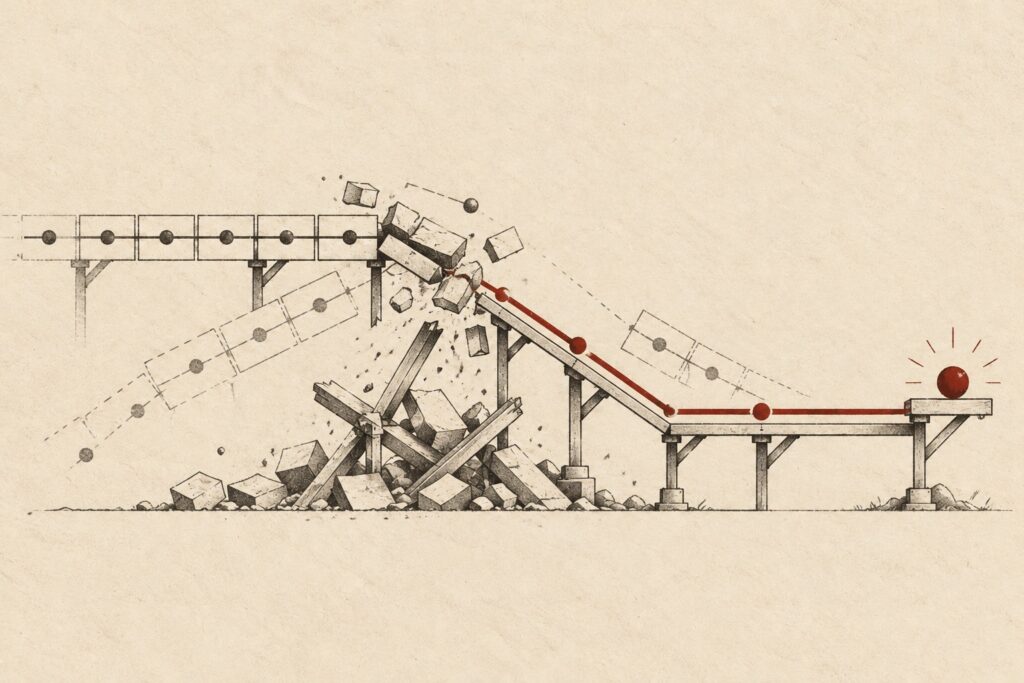
The first email lands at 8:02, a colleague catches you in the corridor at 8:15, and in the shower you remembered a form that was due last week. By nine o’clock the to-do list holds all three, in the order they reached you, and the order quietly becomes the plan. Working through things as they arrive feels fair and orderly, but it is almost always the wrong way to decide what deserves your attention first.
Emergency medicine learned this under far harsher conditions than a Tuesday inbox. When a field hospital cannot treat everyone at once, treating people in order of arrival costs lives. So medicine developed a different method, built for the moment when demand overwhelms capacity and a poor decision is measured in lives. It is called triage, and its core principles carry over to everyday knowledge work with uncomfortable accuracy.
How Larrey sorted the wounded by need instead of rank
Triage began as a rule to treat the wounded strictly in order of medical urgency, whoever they were and whenever they arrived. The word comes from the French trier, to sort, and its modern logic traces to Dominique-Jean Larrey, surgeon-in-chief to Napoleon’s armies, who is widely credited as the founder of modern triage.
Larrey did two radical things. He introduced the ambulances volantes, or “flying ambulances”, light carriages that brought care to the wounded on the battlefield rather than waiting for the fighting to end. He also insisted that the wounded be treated in order of medical urgency, regardless of rank or nationality. A private with a survivable but time-sensitive wound was seen before a general with a graze.
It is worth pausing on how unusual that was. Rank was the organising principle of an army, and Larrey set it aside in favour of a single question: who will be helped most, and soonest, by acting now? Status and sequence gave way to impact.
Much professional prioritisation still runs on rank and sequence. People answer the senior person’s message first, or do the most recent task because it is loudest in memory. Larrey’s real contribution, alongside his compassion, was a decision rule that ignored every signal except the expected benefit of acting. A to-do list keeps exactly what he discarded, treating the order in which things arrived as though it said something about how much they matter, when it usually says nothing at all.
Why triage asks how much acting now will change the outcome
Triage ranks cases by how much acting now will change where they end up, which means severity alone never settles the question. A serious case that will turn out the same whether or not you intervene immediately can wait, while a moderate one that hinges on the next few minutes cannot.
The modern American protocol makes this concrete. START, short for Simple Triage and Rapid Treatment, was developed in 1983 by staff at Hoag Hospital and the Newport Beach Fire Department in California, and it remains the most widely used mass-casualty triage system in the United States. It sorts the wounded into four colour-coded groups: red for immediate, yellow for delayed, green for the walking wounded, and black for the deceased or those who cannot be saved with the resources available.
The black category is the hardest, and the most instructive. Triage deliberately sets aside two groups: those who will be fine without help, and those who cannot be helped enough to justify the resources. Attention goes to the middle band, the cases where intervention makes the greatest difference. A patient who can stand and walk is tagged green and asked to wait. Their pain matters, but acting on them first would change very little.
Knowledge work is full of green tags that get treated as red: the reply that would have been perfectly fine tomorrow, the document that is already good enough to send, the meeting that will go identically whether or not you prepare. It also has its black tags, such as the doomed initiative we keep resourcing or the deal that has already decided itself. The useful question is the one a triage officer asks in seconds. Rather than asking how big a task is, ask how much your acting on it now will change where it ends up.
Why a fast, rough sorting rule works better under pressure
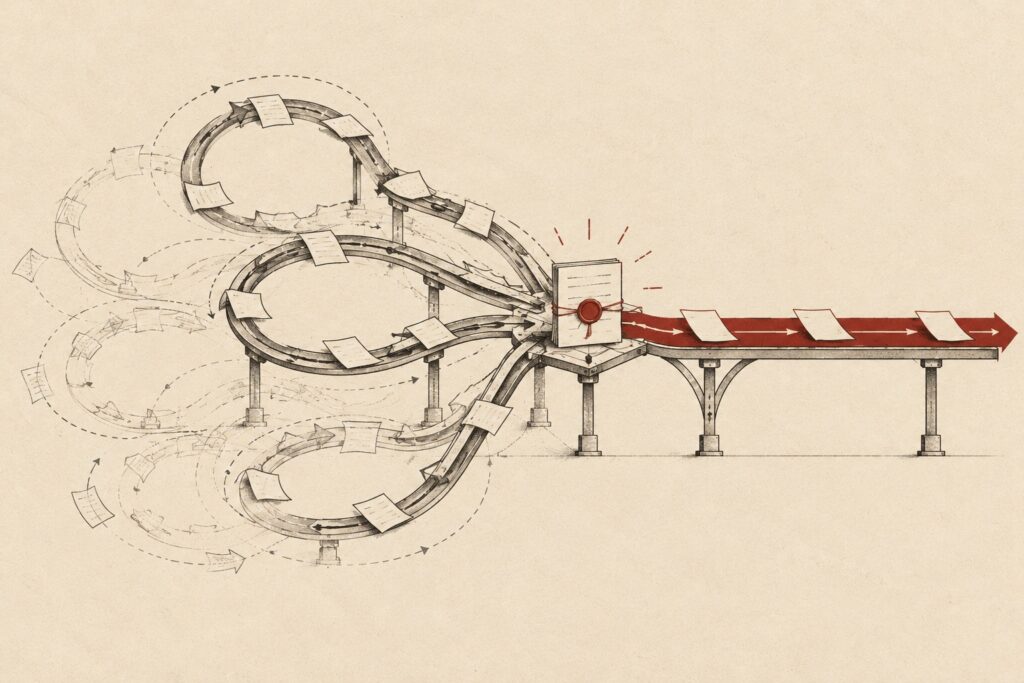
Under pressure, a quick and roughly right rule applied to everyone does more good than a slow, precise one applied to a few. START is striking for how little it asks. An assessor checks whether the patient can walk, whether they are breathing and how fast, whether there is a pulse, and whether they can follow a simple instruction. That is more or less all. The protocol is designed to classify a patient in well under a minute, using signs anyone can read without a laboratory.
The trade is deliberate. A more thorough assessment of each patient would be more accurate person by person and disastrous overall, because while one diagnosis is being perfected, everyone else waits untreated.
Knowledge workers tend to do the reverse. We agonise over the ranking itself, building elaborate prioritisation grids, reshuffling the list, and treating the act of sorting as if it were the work. Triage makes the sorting cheap so that the effort can go into acting. Dwight Eisenhower’s well-known distinction between the urgent and the important points in a similar direction, but triage adds a constraint his quadrants leave out, which is that you may not spend all day deciding. The purpose of the sort is to get you to the red case sooner, and a beautiful list is no help to anyone still waiting.
How to run a thirty-second triage on your own day
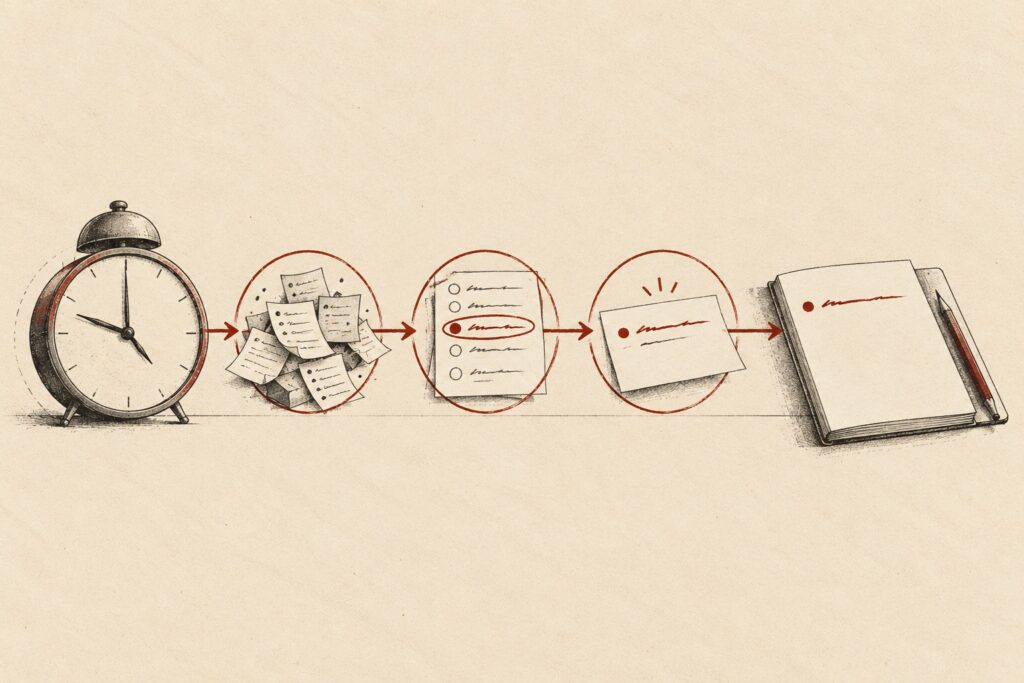
You can borrow the structure directly by running a short triage once each morning, before the queue starts making noise, and asking three questions of the day’s possible work.
The first is Larrey’s question. Which single task will produce the most benefit if you act on it now, regardless of who asked or when it arrived? That is your red tag, the one task to protect.
The second is about consequences. Which items are green, fine if they are delayed or left undone, and which are black, beyond rescue and no longer worth your effort? Both get the same treatment: you let them wait, or you let them go.
The third is about time. Give yourself a fixed, short window to decide, and then commit. A slightly imperfect choice that you act on almost always costs less than a perfect one you are still refining at noon.
A paper diary built for one daily priority quietly enforces this discipline. It has a single line for the task that earns the red tag and deliberately no room for the long queue underneath. That limit does useful work, because a page with space for fifty items invites you to treat all fifty as patients, while a page with space for one makes you sort.
Triage was born of scarcity, the hard fact that there is never enough of the surgeon to go round. Your attention is scarce in the same way, and treating the list as a promise that everything will get its turn ignores the reason to choose one thing in the first place. The wounded are not treated in the order they arrived, and your work need not be either.