How to Stop Reopening Decisions You Already Made
A decision that was never written down gets argued again every time the question comes round. Four short lines on paper are usually enough to settle it.

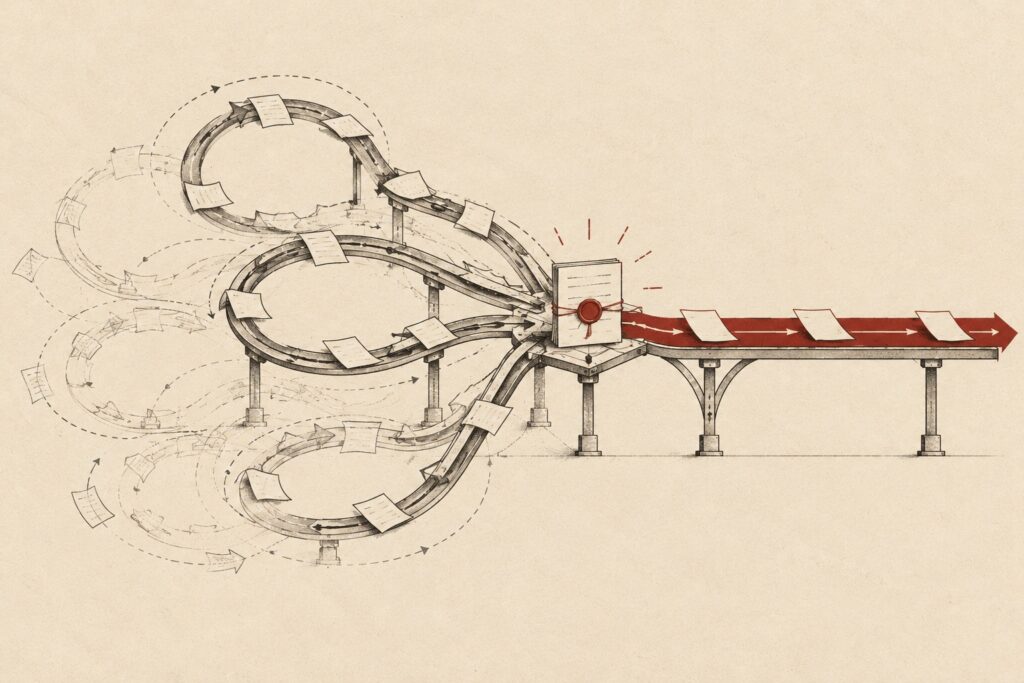
You decided about the project three weeks ago, or at least you are fairly sure you did. Yet here it is again on a Tuesday morning, being weighed against the same alternatives, with roughly the same arguments and no new information on either side. Twenty minutes later you reach the same conclusion you reached last time and go back to work slightly more tired than before.
This is one of the quieter drains on a working week. It produces nothing, it feels like being careful, and it stays almost invisible because each individual round only takes a few minutes.
Why a decision you never wrote down keeps coming back
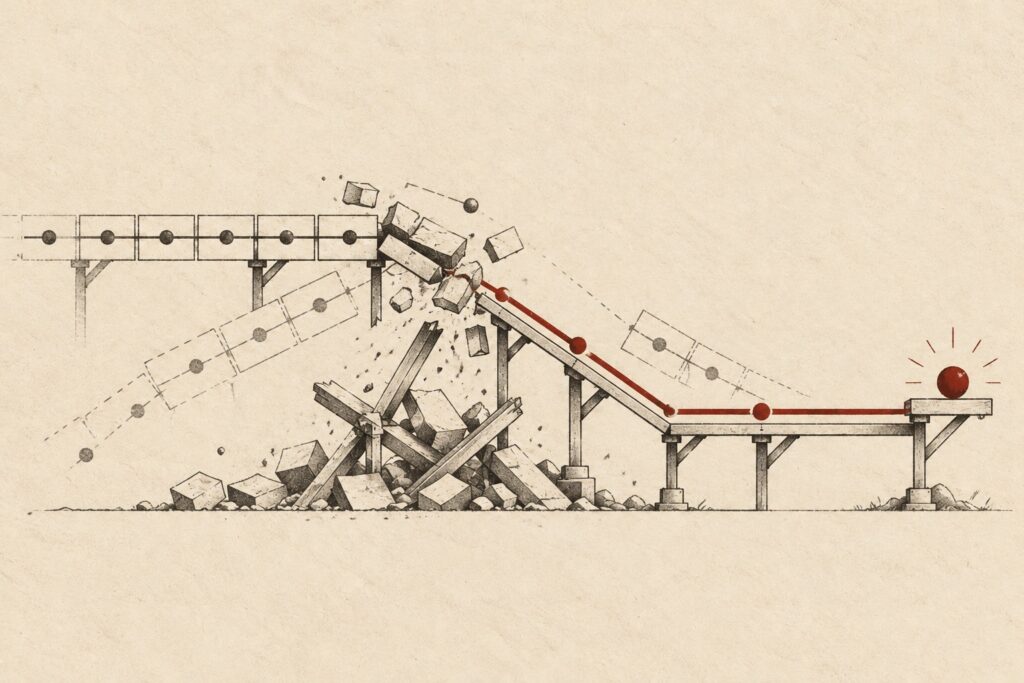
A decision that exists only in memory keeps coming back because there is nothing to check it against, so in a practical sense the question really is still open. What you are left with is a memory of having concluded something, stripped of the reasoning that got you there. When the question returns, you cannot recall what you weighed or why the alternative lost, so you weigh it all again from the start, usually arriving at the same answer at the same cost.
Masicampo and Baumeister found that unfinished goals intruded on unrelated activity, and that making a specific plan for them removed the interference before any of the work was done. Their study concerned goals rather than choices between options, but the lesson carries over reasonably well. What settled things in their experiments was a concrete, written plan, and a conclusion held only in your head has nothing comparable holding it in place.
Seen that way, reopening decisions says less about a lack of decisiveness than about a missing record. A mind with no evidence that a conclusion was reached will sensibly treat the question as live.
What to write down when you make a decision
Write down the reasoning as well as the answer, because the answer on its own will not hold. Going with A is close to useless three weeks later. You will not remember why you chose it, so the first time anything about A looks awkward, the whole comparison opens up again.
Four short lines are enough:
What was decided. One plain sentence.
What it was chosen over. Naming the option that lost stops it from coming back later dressed as a fresh idea.
Why. The one or two reasons that actually settled it, rather than the full argument.
What would change it. The specific condition under which you would look again, such as if the supplier can’t commit by March.
The last line is what makes the record last. Without it, every new scrap of information becomes a candidate for reopening, and you have no way to tell a genuine trigger from an ordinary wobble.
How to tell new information from ordinary discomfort
Each time the decision resurfaces, ask a single narrow question: has something actually changed? Most reopenings are prompted by discomfort rather than by information. The path you chose has become hard going, or the one you turned down looks smooth from a distance, or you are simply tired. None of those is a new fact, and a decision remade on the strength of any of them will itself be reopened next month for exactly the same reasons.
Barry Schwartz’s argument in The Paradox of Choice helps explain why the pull is so persistent. Past a certain point, more options make choosing feel worse, and an awareness of the options you passed over tends to linger afterwards as a nagging sense that something better was available. Nothing about the chosen path has changed, but the alternatives keep casting a shadow over it.
With the written trigger in front of you, the check takes seconds. Has the named condition occurred? If it has not, the decision stands, and you have spent a few seconds on it instead of twenty minutes.
How to reopen a decision properly when it is warranted
Decisions should sometimes change, and when they do, the change should be made on purpose rather than allowed to drift. If the trigger condition really has occurred, reopen the decision properly. Sit down, weigh it once, decide again, and write a fresh record with its own trigger. What wears a week down is the third state, where the decision is neither committed to nor formally revisited and is instead quietly re-argued in the background, so that no version ever holds.
A deliberate reversal might cost an hour and leaves things settled. Endless reconsideration costs more than that over a month and leaves everything unsettled.
The same distinction helps with commitments that have gone dormant without anyone closing them. If something keeps returning and you neither commit to it nor drop it, the honest answer is often an ending, written down with a sentence saying so, rather than a better-kept decision record.
How the same problem plays out in a single day
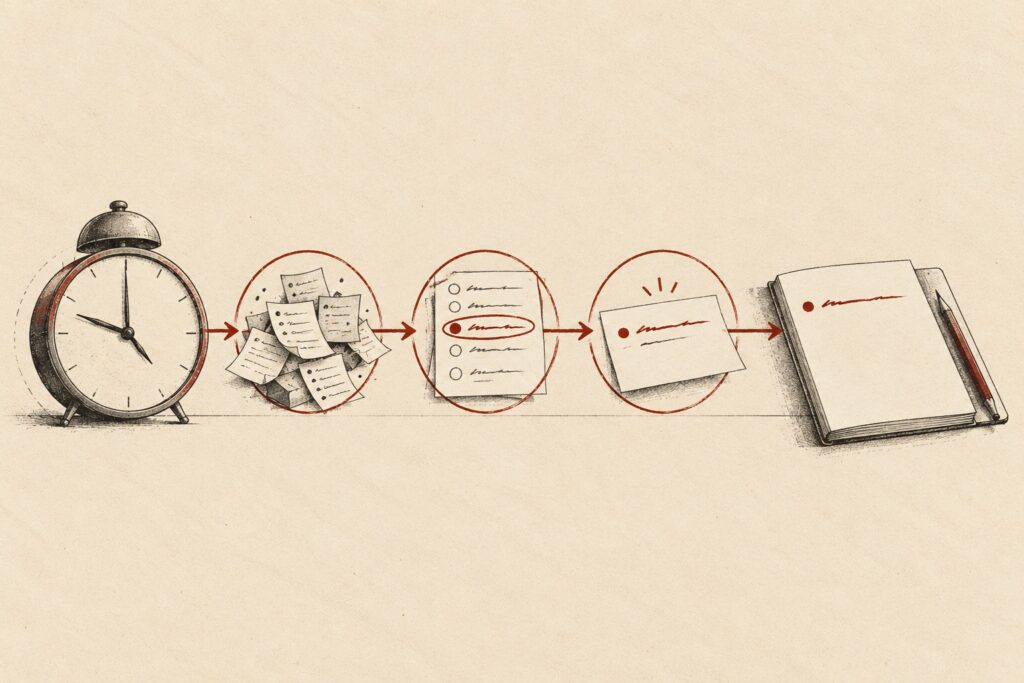
The same pattern runs at a much smaller scale every day, and that is where most of its cost builds up. Last night you decided what today’s one thing would be. At ten past nine something appealing arrives, and the decision is quietly run again, this time by a person under pressure who is comparing a quiet, important task with a loud, urgent one. That comparison has a predictable winner, which is exactly why it was worth settling the evening before.
Gollwitzer’s research on implementation intentions found that fixing when, where and how you will act improves follow-through compared with holding the goal in general terms. Tomorrow’s written line serves as that specification, and it has a second use here as well, which is to make any overruling visible. You can still change your mind at ten past nine, but you cannot do it without noticing, and noticing is most of what writing it down buys you.
That is the practical connection between recording decisions and making the first line of the day hold. An intention that was never written down gets decided again every morning, by whoever you happen to be at the time.
Why decisions that need review should get a fixed time
Decisions that genuinely need revisiting should be given a set time, so they stop surfacing whenever they please. Some things deserve a periodic look, such as a standing arrangement, the direction of a project, or whether something dormant ought to be closed. Give those ten minutes on a Friday or a monthly pass, and treat everything else as out of scope until then.
This works for the same reason batching admin works. Thinking a decision through is cheap enough; the expensive part is having it arrive at unpredictable moments in the middle of hours that needed continuity. A decision reviewed on schedule costs ten minutes a month. The same decision revisited whenever it happens to occur to you costs far more and tends to produce a worse answer, because it gets weighed in whatever state you are in at that moment.
The Do One Thing diary holds one line a day and a short weekly review page. Its job here is narrow: the decision exists in writing, made calmly the night before, so the morning has something to check against instead of a question to answer all over again.
Most of what feels like indecision turns out to be a filing problem. You reached the conclusion long ago, and it simply was never written anywhere the next version of you could find it.