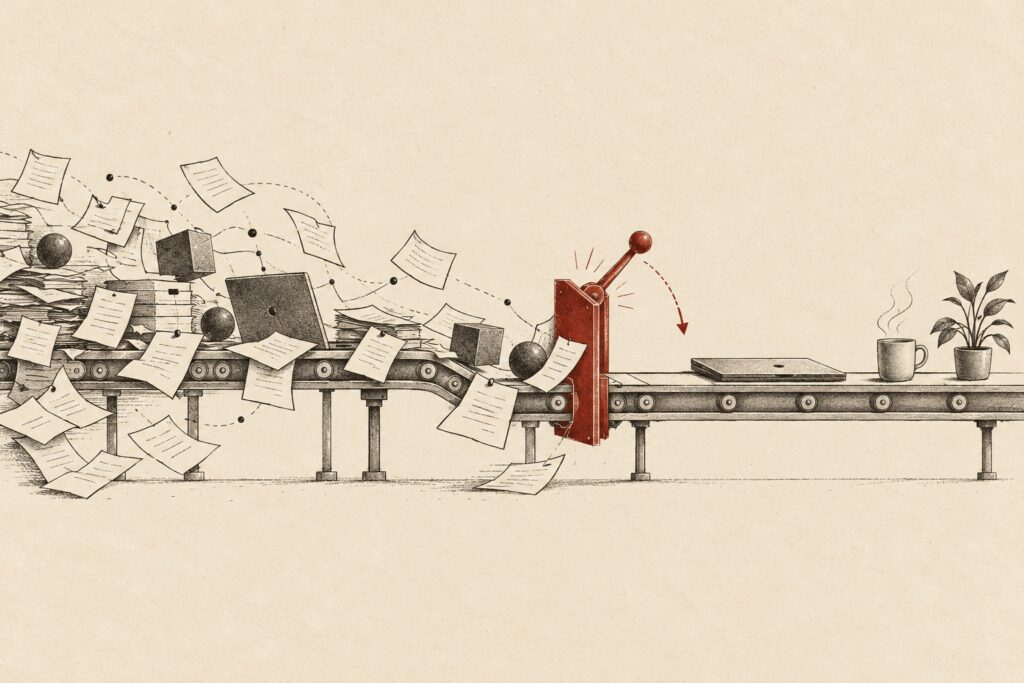
Burnout Isn’t a Willpower Problem. It’s an Engineering Problem.
There is a quiet cruelty in how most of us explain our own exhaustion. When the alarm becomes an enemy, when Sunday evenings curdle with dread, when the work that once felt…

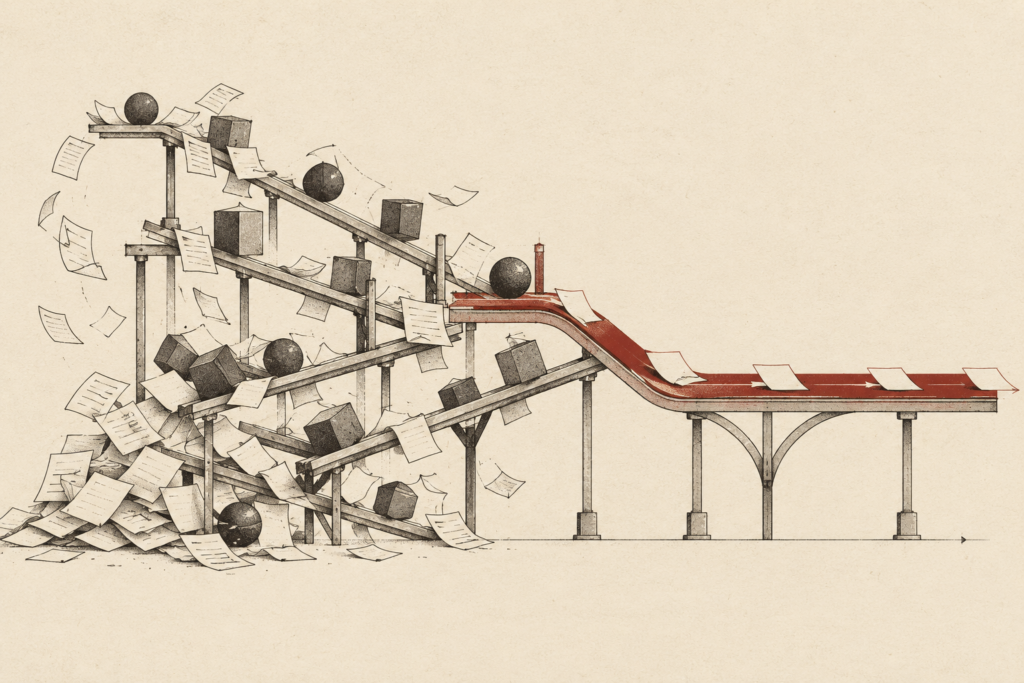
A manager closes her laptop at nine in the evening, looks at the list she has barely touched, and decides the fault is hers. Most people reach the same conclusion when the alarm starts to feel like an enemy, Sunday evenings fill with dread, and work that once felt meaningful becomes like wading through wet sand. The first explanation is almost always personal: I’ve got lazy, I’ve lost my edge, I just need to push harder. It is a little like treating the warning light on a car’s dashboard as proof that the driver is weak.
The research tells a different and far more useful story. Burnout looks much less like a shortage of willpower than like what happens when a system is asked to deliver more than its design can sustain. That is encouraging, because a badly designed system can be redesigned.
How researchers and the WHO define burnout
Researchers define burnout as a measurable syndrome of exhaustion, cynicism and a fading sense of accomplishment, and they locate its causes largely in the working environment.
The modern study of burnout begins with the social psychologist Christina Maslach, who spent decades at Berkeley documenting it as something that could be measured rather than a vague mood. Her work, formalised in the widely used Maslach Burnout Inventory, identifies three components. The first is emotional exhaustion, the sense of being drained and used up. The second is cynicism or depersonalisation, a growing detachment from the work and the people in it. The third is a reduced sense of personal accomplishment, the feeling that nothing you do amounts to much. Maslach has long argued that burnout is best understood as a relationship between a person and their environment, rather than as a flaw lodged inside the individual.
In 2019 that view received its most official endorsement. The World Health Organization, in the eleventh revision of its International Classification of Diseases (ICD-11), described burnout as an “occupational phenomenon” resulting from “chronic workplace stress that has not been successfully managed.” The WHO was careful to say that burnout is not classified as a medical condition and that the term belongs to the work context, rather than to every area of life. It is worth reading that definition slowly. The cause it names is unmanaged, chronic stress within a working system, and the diagnosis points outward at the conditions far more than inward at the person suffering them.
How the job demands-resources model explains burnout
The Job Demands-Resources model explains burnout as the predictable result of high demands meeting low resources over a long period. It was developed by researchers including Evangelia Demerouti and Arnold Bakker around the turn of the millennium, and it describes every job along two dimensions. On one side are demands, such as workload, time pressure, emotional labour, role conflict and mental strain, all of which cost energy. On the other are resources, such as autonomy, social support, feedback, mastery, a clear sense of purpose and the tools that help you get things done.
The model’s central idea is almost mechanical. In later work, Bakker and Demerouti describe demands as driving a health-impairment process that drains energy and, sustained for too long, leads to burnout, while resources drive a separate motivational process that builds engagement. Weak character has very little to do with it. Someone with enormous reserves of discipline will still burn out if their demands keep rising while their resources stay flat, in the same way that a sound engine will eventually fail if it is run beyond its rated load with the oil light on.
That is why the usual self-improvement advice so often fails. Telling a burned-out person to try harder is like responding to an overheating engine by pressing the accelerator. Effort cannot close a gap between demands and resources, because effort is one of the things the demands are already consuming.
Why treating burnout as a personal failing makes it worse
Treating burnout as a personal failing makes it worse because it sends you back into the same conditions with the same load, now carrying shame as well. Once burnout is seen as a design problem, it becomes easier to understand why the personal story is so tempting. It preserves a sense of control: if the problem lies in me, then I can fix it through resolve. Unfortunately, resolve leaves the demands exactly where they were.
Maslach has made this point repeatedly, observing that organisations often offer individual remedies for what are essentially organisational problems. A yoga class or a meditation app can have real value, but each is a small resource bolted onto a machine whose demands nobody has examined. They ease the symptoms while leaving the underlying imbalance in place. When the mismatch is structural, individual coping can buy some time, but it rarely solves the problem on its own.
The same logic applies to the way most people run their own days. A typical personal system is built almost entirely around demands. The to-do list generates them endlessly: it grows without limit, it never signals that you have done enough, and it offers nothing back except a steady reminder of everything still undone. A list of forty items gives you very little guidance about what to do, and quite a lot of daily evidence that you are falling short.
How to lower the demands and raise the resources in your own day
You can apply the model to your own day by lowering the demands you accept as today’s work and raising the resources that keep you going. Both are within reach even when you cannot rewrite your job description.
The first lever is to reduce demands where you can, which usually means sharply cutting the number of things that count as today’s work. The aim is to stop treating everything as equally urgent, while still doing the work that matters, because a system that prioritises everything prioritises nothing and wears itself out trying. Choosing the single most important task for the day is a form of load management. It brings the demand side back within a range your resources can actually sustain.
The second lever is to increase resources, and one the research returns to often is a sense of accomplishment and progress. Teresa Amabile and Steven Kramer, analysing thousands of daily diary entries from working professionals for their book The Progress Principle, found that making progress on meaningful work was the event most associated with good working days. For someone running low, that points to a resource that costs nothing to create: the felt sense of having moved one real piece of work forward.
That is why the modest practice of deciding on one thing, doing it and marking it done amounts to more than tidiness. It restores the resource the to-do list tends to strip away, so that the day can end with some evidence of progress rather than a ledger of what you owe. A simple paper diary built around a single daily intention does quiet structural work here, keeping the day’s demand to one line and giving you a place to mark it done.
None of this asks you to become a different or more disciplined person. It asks you to treat your days as a system you are allowed to redesign, lowering the demands where you can, protecting the resources that keep you going, and building for sustainability rather than heroics.
The exhaustion you feel says much less about your character than about the load you have been carrying, and the load, unlike your character, is something you can change.