How to End the Workday on Purpose
Most working days are abandoned when the energy runs out. A deliberate ten-minute close is what turns an evening away from work into actual rest.

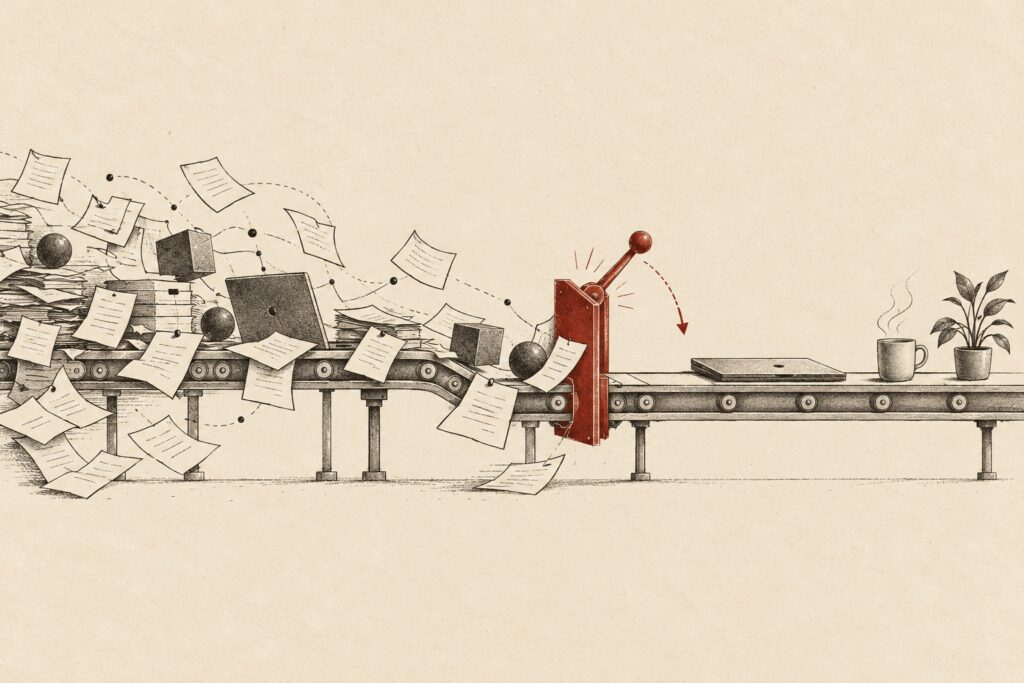
It is ten to six, the call has just ended, and you close the laptop halfway through a thought about the report. Nothing about the work is finished; you have simply run out of day, or energy, or a reasonable excuse to keep going. Then you carry the half-finished thought into the kitchen, through dinner and, quite often, into the moment you switch off the light.
Most working days end like this, by being abandoned at whatever point the energy gives out. That is why an evening can contain no work at all and still leave you unrested the next morning. Being away from the job and being done with it for the day are different states, and only the second one lets you recover.
Why an evening away from work can still leave you tired
An evening away from work can still leave you tired because recovering depends on mentally letting go of the work, and that does not happen just because you have left the desk.
Sonnentag and Fritz, developing a measure of recovery experiences, identified psychological detachment, meaning mentally disengaging from work during time off, as one of four, alongside relaxation, mastery and control. What makes that useful for the end of the day is that detachment appears as an experience in its own right, separate from simply being off the clock.
Most people will recognise the evening it describes. You spend the whole of it at home, do no work whatsoever, and still feel as though you never really stopped, because the open items kept running in the background the entire time. Your hours were your own, but your attention was still on loan to the office.
So detachment is something you do, rather than something a time of day hands you, and doing it takes around ten minutes.
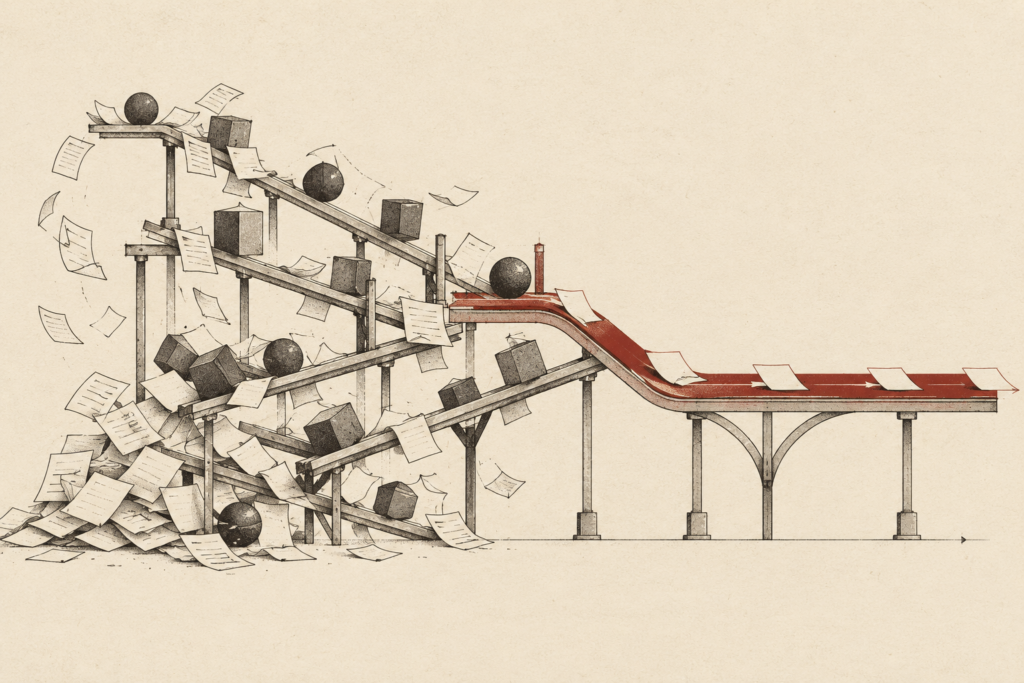
What makes unfinished work follow you home
Unfinished work follows you home when it has no decided next step, and it tends to stay quiet once it has one.
Masicampo and Baumeister found that unfinished goals kept intruding on unrelated activities, and that making a specific plan for them removed the interference before any of the work was done. What that means for the end of the day is that the evening’s mental noise depends less on how much is unfinished than on how much is undecided. Four open tasks, each with its next action written down, make for a quieter evening than two that were simply dropped where they stood.
It also explains why staying an extra hour so often makes the evening worse. The extra hour rarely closes anything. More often it opens something new, and then you stop at the point of greatest uncertainty, with even more left undecided than before.
A ten-minute close that ends the day deliberately
To end the workday on purpose, spend the last ten minutes doing four small things in a set order.
First, go through whatever is still unfinished and give each item a sentence saying where it has got to and what happens next. Three or four sentences usually cover it, and this is the step that quietens the evening, which also makes it the one most tempting to skip when you are tired.
Second, answer a single question about the day: did the thing that mattered get done? A plain yes or no is easy to answer when you are depleted, whereas a score out of ten lets guilt back in by a side door and gives you nothing to act on.
Third, write tomorrow’s one line, specific enough that you could start on it without deciding anything. A verb and a first move will do it, and a broad topic will not. The line is what keeps tomorrow morning from being spent choosing.
Fourth, stop in a way you can see. Close the machine, clear the desk, leave the room, and do it the same way each day so that the boundary becomes something that happened rather than something you drifted past.
Why stopping needs a visible signal
Stopping needs a signal because without one the evening slides into a long stretch in which you are neither working nor resting.
That stretch looks like checking something at seven and turning a problem over at nine. It produces no work and no recovery, which makes it about the most expensive hour of the day.
What the signal is barely matters. It can be putting the laptop away, a short walk, or tidying the desk. What counts is that it is the same each day and impossible to mistake, because a slow fade is exactly what produces the difference between never working and never finishing.
Where in the work to stop so tomorrow starts easily
Stop partway through something, at a point you can pick straight back up, instead of at a clean break.
The instinct is to finish the section, close the loop and leave everything tidy. It feels better in the moment and makes tomorrow harder, since a completed piece of work offers nothing to take hold of and you start the morning from a blank page.
Stopping in the middle of a sentence or a section leaves an obvious way back in. Tomorrow’s first move is then to carry on with something rather than to begin something, which is far easier for the reluctant person you tend to be first thing.
Combine that with the written line and the morning holds neither a decision nor a blank page. Both of the hard parts were dealt with the evening before, by someone calmer and better informed.
This is also why the evening deserves protecting instead of stretching. Rest is the condition that makes the next day’s work any good, and it is the other half of doing hard things rather than a reward for having done them. An evening spent half-working gives you neither the work nor the rest, and it is the most common way a good week slowly turns into a poor one.
Why the close matters most on the hardest days
The close does the most good on the days that overrun, which are also the days it feels least possible.
Mark, Gudith and Klocke found that people who were interrupted finished their tasks faster and without losing quality, but at the price of more stress, frustration, time pressure and effort. A badly interrupted day can therefore look perfectly ordinary on the calendar while leaving you drained, and that is the kind of day most likely to end in the slow fade.
Ten minutes at the end of a bad day is worth more than ten at the end of a good one. If only four minutes are available, use the four. A practice that cannot survive being done badly will only ever happen on the days that did not need it.
A ten-minute close can only fix so much. If you remain tired for weeks however well your days end, or your sleep or appetite have changed, a doctor is the right person to talk to, because that is more than a scheduling problem.
The Do One Thing diary is built around this end of the day, with a printed page for tomorrow’s one line, written tonight, and a short weekly review. There is nothing on it to check or maintain, which is what makes it usable at nine in the evening when little else would be.
An abandoned day takes the evening along with it. A day that has been closed lets the evening go, and the difference costs about ten minutes of writing.