Flow Isn’t a Mood: The Three Conditions Csikszentmihalyi Found Behind Peak Concentration
Ask most people what “flow” is and you’ll get something atmospheric: a vibe, a mood, a lucky afternoon where the words came easily. The word has drifted so far into wellness marketing…
Ask a colleague what “flow” means and you will usually get something atmospheric: a mood, a good spell, a lucky afternoon when the words came easily and the hours went missing. The word has drifted so far into wellness marketing that it often means little more than “felt good while working”. That drift is a loss, because the original research is far more precise than the popular version, and far more useful to anyone trying to plan a day.
Csikszentmihalyi described flow as a state with specific, repeatable preconditions. Once you know what they are, you can arrange your work so that flow becomes more likely, instead of waiting and hoping for one of those afternoons to turn up.
What Csikszentmihalyi actually studied, and how he measured it
Mihaly Csikszentmihalyi, the Hungarian-American psychologist who gave the state its name, was studying how people experience absorbing activity, and he spent decades on it. He interviewed people who reported losing themselves in what they did: rock climbers, surgeons, chess players, composers and factory workers. What struck him was how similarly they described the experience whatever the task. They spoke of action and awareness merging, of time running strangely, and of self-consciousness falling away. He set this out in his 1990 book Flow: The Psychology of Optimal Experience, drawing on research that stretched back to the 1970s.
His method went well beyond collecting stories. Csikszentmihalyi pioneered the Experience Sampling Method, in which participants carried pagers, were beeped at random moments through the day, and wrote down what they were doing and how they felt. That allowed him to map, statistically, the conditions under which flow tended to appear. The result was a body of evidence about when and why concentration deepens, which is a good deal more useful than a collection of memorable peak moments.
The finding most worth remembering is that flow turned up most often during effortful, structured activity, and less often during leisure. People in his studies reported flow more frequently at work than while relaxing, even though they consistently said they would rather have been relaxing. The state we associate with ease turns out to be produced by demand.
The three conditions that make flow more likely
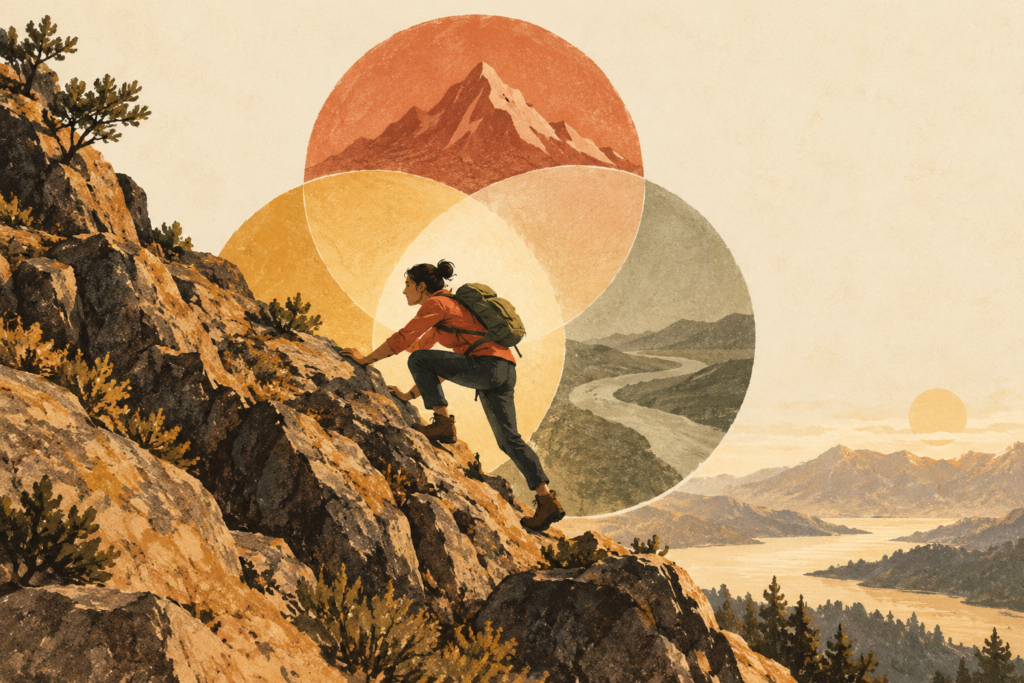
Across his data a small set of preconditions appears again and again, and three of them do most of the work.
The first is a balance between challenge and skill. Flow sits in a narrow channel between anxiety and boredom. When a task far exceeds your ability, you become anxious and pull away from it; when it sits well below your ability, you get bored and drift. Flow appears when the difficulty stretches your skills to roughly their current limit and no further. That is why the same activity can absorb you one month and feel like a chore the next, because as your skill grows, the challenge that once fitted you stops fitting. The balance has to be kept up over time, since finding it once is never enough.
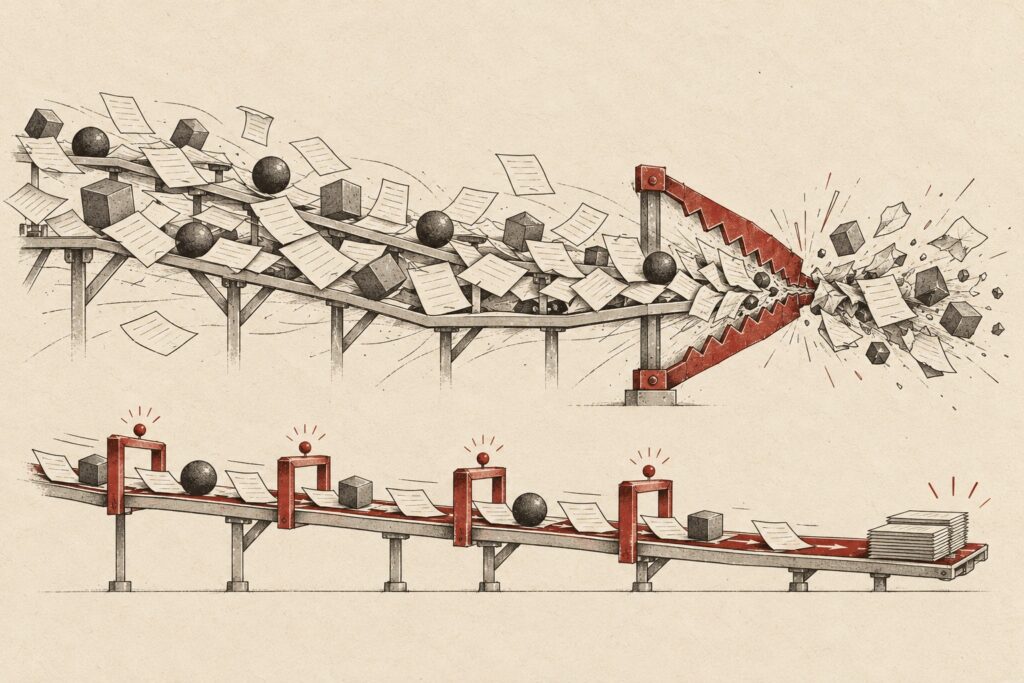
The second is a clear goal. Flow needs an unambiguous sense of what you are trying to do right now. A climber’s goal is obvious, because it is the next hold, and a surgeon’s is the next step in a defined procedure. Vague, sprawling objectives such as “make progress on the report” leave attention with nothing to grip. This is one reason a long, undifferentiated to-do list is so damaging to deep concentration: it offers many half-defined goals at once, and the mind cannot settle on any one of them.
The third is immediate feedback. You need to know, moment by moment, whether what you are doing is working. The climber feels the grip hold or slip, and the musician hears the note land or clash. Where feedback is delayed or missing, attention frays, because there is nothing to correct against. Work with naturally tight feedback loops, such as writing a line and rereading it or solving a problem and testing the answer, is easier to sink into than work whose results you will not see for weeks.
How Steven Kotler extended the research, and how it gets distorted
The journalist and researcher Steven Kotler has spent years translating flow into the language of neuroscience. Through his Flow Research Collective he has popularised the idea of flow “triggers”, the environmental and psychological conditions that tend to come before the state. He has also described the brain changes thought to accompany it, including what researchers call transient hypofrontality, a temporary quietening of parts of the prefrontal cortex during deep flow. His book The Rise of Superman studied extreme-sports athletes precisely because their feedback is instant and the stakes make the line between challenge and skill impossible to miss.
Kotler’s work is useful, but it is also where distortions creep in, often from people quoting him more than from Kotler himself. Flow gets sold as a superpower you can summon at will, a switch flipped by the right playlist or supplement. The research does not support that. Flow follows from conditions, and while you can stack the deck in your favour, you cannot guarantee how the cards fall.
Two distortions are worth naming. The first is the belief that flow is mostly a matter of reducing distraction. Removing interruptions certainly helps, but a silent room does nothing if the balance between challenge and skill is wrong, and it is perfectly possible to be undistracted and bored at the same time. The second is treating flow as the purpose of work. In Csikszentmihalyi’s account it is a by-product of doing demanding, well-structured work for its own sake, and chasing the state directly tends to push it further away. Building the conditions is what lets it arrive.
How to arrange a working day so flow can happen
In practice, getting more flow means spending less effort on trying to feel a certain way and more on arranging the three conditions.
Start by picking one task that genuinely stretches you. That rules out the busywork that bores you and the overwhelming project that frightens you, and leaves something near the edge of your current ability. Define its goal narrowly enough that you know exactly what doing it looks like in the next hour. Then choose work where you can see your own progress as you go, or build that feedback in on purpose, for instance by setting yourself a small checkable target.
All three conditions push in the same direction, towards doing one demanding thing, clearly defined, with your full attention, instead of scattering yourself across a dozen open loops. That is why the single-task discipline matters for more than tidiness. A focused day is calmer, and it is also better built to produce the deep concentration Csikszentmihalyi documented. Choosing the one task that matters most and committing to it can act as a flow trigger in its own right, because it satisfies the clear-goal condition before you have written a word.
If it helps to make that choice visible, the Do One Thing diary exists for exactly that purpose, with a single line for the one task you will give your attention to today. The tool itself is incidental, though, and the principle works just as well on a blank index card.
Flow tends to visit people who are engaged far more often than people who are simply relaxed. Engagement can be built on purpose, one well-chosen task at a time.