September and the Second New Year
September brings a fresh start with no audience, more realistic expectations and about fifteen usable weeks left, making it the better restart of the two.

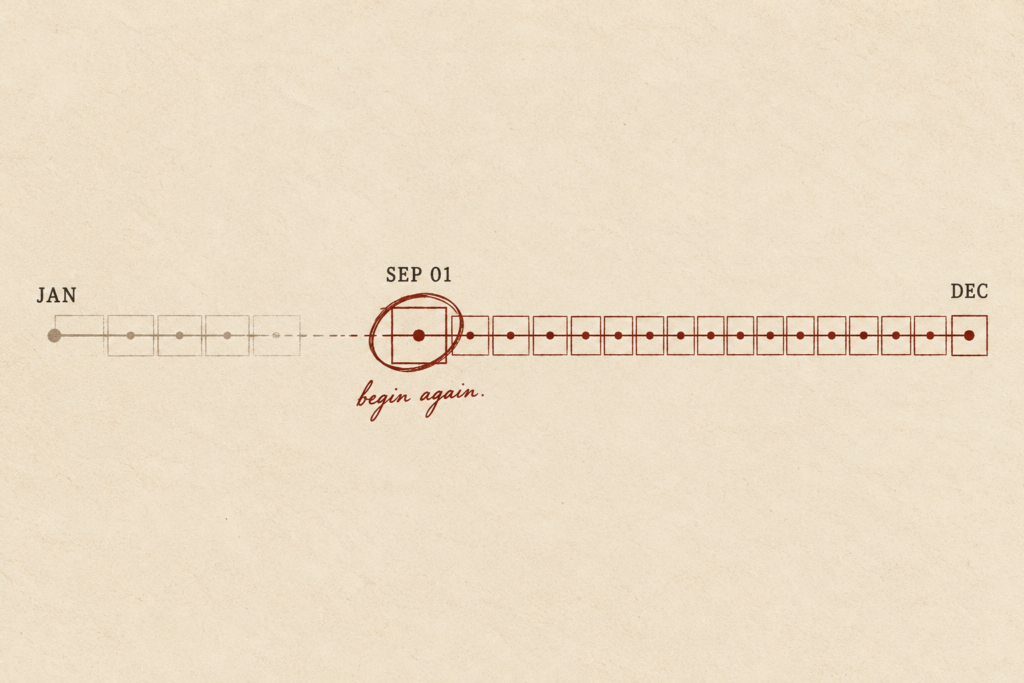
Somewhere in the first week of September an old instinct stirs. The looseness of summer comes to an end, the alarm goes back on, the school run or the commute returns, and for a few days the year feels oddly new again. Two decades of school terms put that feeling there, and most of us never quite lose it.
Most people notice the feeling and let it pass. That seems a waste, because in most respects September is a better point to start something than January, and the reasons are worth taking seriously.
Why the September feeling is a measured fresh-start effect
The September feeling is one instance of a well-documented pattern, in which people become more willing to pursue goals just after a point in time that marks a new beginning. Hengchen Dai, Katherine Milkman and Jason Riis called it the fresh start effect and found it across three archival field studies: Google searches for “diet”, gym visits and commitments to pursue goals all rose after temporal landmarks such as the start of a week, a month, a year or a semester, a birthday or a holiday. Their proposed explanation is that a landmark files the old self’s failures under a previous period and encourages a wider view of your life.
The semester finding deserves attention. It means the September pull is one of the landmarks the researchers actually measured, showing up in gym attendance and goal commitments, and something far more widely shared than a private habit left over from school.
The practical reading is that a landmark is a resource, a stretch of days when beginning something feels easier than it did the week before. January is the most famous of these moments and also the most overloaded, and September offers the same resource under better conditions.
It comes with realistic expectations. January commitments are made at the turn of the year, about as far from ordinary life as the calendar gets. September commitments are made in the middle of things, by someone who was at work last Tuesday and knows exactly what a normal week holds. Polivy and Herman described a false hope syndrome, in which attempts to change fail because of unrealistic expectations about how fast, how much and how easily things will change. January’s conditions feed that pattern, and September’s give it much less to work with.
It comes without an audience. Nobody announces September resolutions, so the second new year avoids the early sense of satisfaction that telling people about a goal can bring. Whatever you begin now exists only as something you do, which tends to be the form that lasts.
It has a built-in end. From September to mid-December there are roughly fifteen usable weeks with a firm boundary at the end of them, which is long enough for something real and short enough to stay concrete. January offers a vague twelve months, while September offers a term, and a term has a finish.
How to set up a September start so that it lasts
A September start works best when you choose one thing, tie it to the routines that are coming back anyway, and size it for a bad week. Import the full January approach and the advantage disappears.
Choose one thing instead of a programme. The reset feeling will suggest overhauling everything at once, from your routines and health to your projects and systems. That urge comes from the landmark and says little about how much you can actually take on. Choose the single thing that would matter most by December and let everything else carry on as it was. Fifteen weeks is enough for one real thing and nowhere near enough for a complete reinvention.
Fix it to a routine that is returning. For a week or two in September, daily life is being reassembled: the same train, the same drop-off time, the same first coffee at your desk. Those fixed points are not yet settled, so a new activity can be slotted in beside one of them before the week hardens again. Peter Gollwitzer’s research on implementation intentions found that deciding when, where and how you will act improves follow-through compared with holding the goal alone. September gives you unusually good material for that decision. After the school drop-off, forty minutes on the draft is a plan that only makes sense once the drop-off exists again, which is exactly why January cannot write it.
Size it for October. The test is still the worst plausible Thursday of the term rather than the hopeful first Monday. A version small enough to survive the hardest week before Christmas is the version that reaches December, which is the same rule that applies to any resolution that fits on one line.
Why September is a good moment to look back at the year
September allows a kind of review that January cannot, because two-thirds of the year has gone and there is still time to act on what you find.
Twenty minutes on three questions is enough. What has actually moved since January? What has kept being pushed aside all year? Is there one thing that, in the fifteen weeks left, would change how December feels? A review in December can only deliver a verdict, whereas one in September can still lead to a correction, and that makes it the more useful of the two.
If January’s intentions collapsed, this is also a good moment to restart them properly, at a smaller size, tied to a cue and without any ceremony, instead of waiting four more months for the calendar to give you permission. The steps are the same as for any February recovery: write one line tonight, do the small version tomorrow, and leave the gap unexplained.
How to use the hard stop in mid-December
The firm end to the autumn term is the feature January lacks entirely, so it is worth using on purpose.
Give the fifteen weeks one honest target, such as a finished draft, a completed course or a habit that has reached its fifteenth week. Then work backwards to a weekly input you control and let each day’s line follow from that. A term with a named end tends to leave you with a December that contains a result. An open-ended resolution tends to leave you with a December that contains a shrug.
When mid-December arrives, stop. Review the term, close it, and let the last fortnight of the year be the rest it is meant to be. A term that ends well also makes the January landmark more useful, because you come to it with recent evidence of what fifteen weeks can actually hold.
Working in terms has a quieter benefit that only becomes visible after a few of them. A year of open-ended intentions produces one verdict in December, and it is usually vague. A year divided into two or three bounded terms produces two or three complete cycles, each one chosen, run, reviewed and closed, and each teaches you something the next can use. People who seem unusually good at judging what they can do in three months have mostly just completed more three-month stretches and written down what happened.
The Do One Thing diary suits a September term well. It has five printed pages, one line a day and a weekly review, so it is a bounded object for a bounded stretch, started in the first week of term and finished along with it.
The pull you feel in early September is a genuine fresh start, and it arrives under better conditions than the famous one: it is quieter and more realistic, and it leaves time on the clock. Anyone who uses it gets fifteen weeks’ head start on everyone waiting for January.