How to Handle the Day Your Plan Collapses
When the schedule falls apart at half past ten, recover by making one fresh decision and keeping it, rather than re-planning every hour that is left.

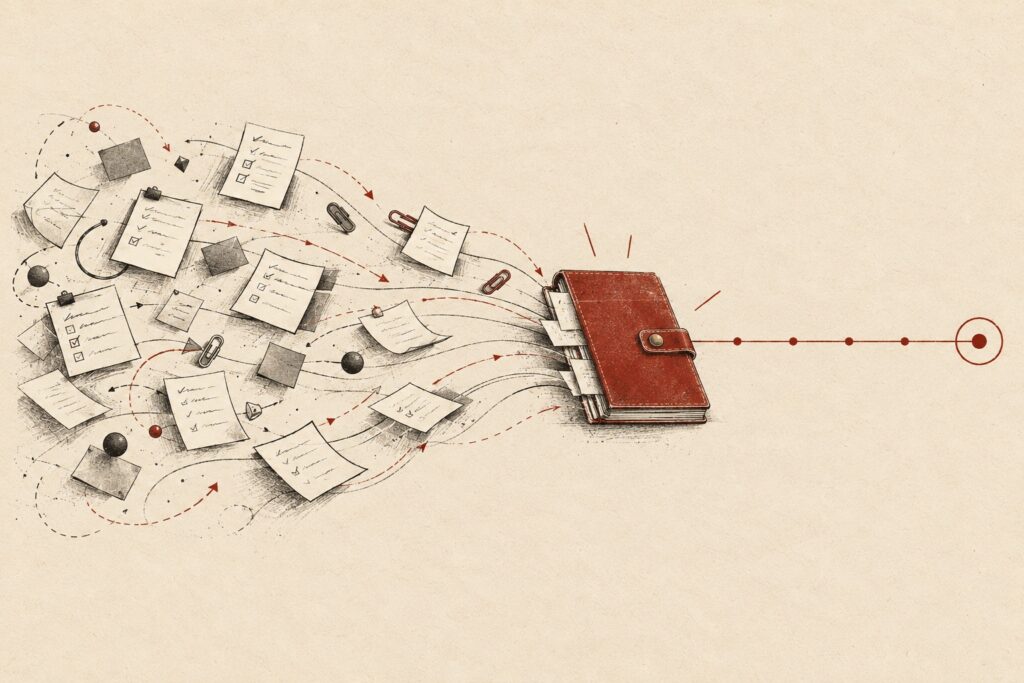
By twenty past ten the day is unrecognisable. Something broke, or someone escalated, or a meeting handed out three hours of work nobody had planned for, and the careful arrangement you made last night now describes a day that is not going to happen. You look at the schedule, still sitting there in its neat blocks, and feel the familiar pull to fix it.
What follows is usually worse than the disruption itself. The remaining hours go on a rolling attempt to rescue the plan: reshuffling, re-estimating, deciding and then deciding again. By the evening the original work is untouched, and you have no clear account of where the time went.
Why a detailed plan was likely to break anyway
A detailed plan was likely to break because the estimates inside it were almost certainly too optimistic from the start. Buehler, Griffin and Ross showed that people underestimate how long their own tasks will take, even when they know that similar tasks overran before. Experience of being wrong does surprisingly little to correct the next estimate.
That changes what a broken day means. A tightly timed schedule is best understood as a reliably hopeful document, and a day that departs from it is the ordinary case. Treating the collapse as an anomaly is what makes the response so costly, because you spend the afternoon trying to restore a picture of the day that was never accurate.
The more closely sequenced the plan, the harder it falls. Each block depends on the one before it finishing on time, so a single overrun undoes everything downstream, which is why a perfectly planned day loses harder than a loosely held one.
How to re-choose the day once and then stop deciding
The most useful thing to do on a broken day is to make one new decision and then leave it alone. On the day your plan collapses, recovery comes from a single act of choosing, made once, rather than from a running effort to restore the schedule.
Give it two minutes. Look at the time that is genuinely left, as opposed to the time you hoped to have, and ask one question: of everything on the original plan, what is the largest piece that can still be finished today? Write that down. Move everything else to tomorrow, explicitly and in writing, so it is no longer competing for the afternoon.
Then resist revisiting it. As new information arrives there will be a steady temptation to adjust the answer, and each round of adjustment costs attention while improving the answer very little.
Sophie Leroy’s research on attention residue helps explain why those rounds are so draining. After a switch, part of your attention stays with the task you left, and the effect is strongest when that task was unfinished. Re-planning every half hour amounts to switching every half hour, and every task involved is unfinished by definition. That is how people end a broken day exhausted by work they never actually did.
How to shrink the day’s target instead of writing it off
After a collapse, the better move is to shrink the target to something that can still finish today, rather than giving the day up. Writing the day off feels honest, but it is usually a larger response than the situation calls for.
Amabile and Kramer’s diary research found that making progress on meaningful work was the event most associated with good working days, and that the progress in question was often modest. For a broken day, that is the useful part. Nobody needs the whole day rescued; it is enough for one real piece of work to have moved.
So the question to ask is which fragment of the original ambition can genuinely be completed in the time available. That might be one section instead of the chapter, one call instead of the whole round of follow-ups, or the outline instead of the draft. Forty minutes of the right work, finished, changes how the day feels and what it leaves behind in a way that four hours of scattered salvage rarely does.
What to do when no useful time is left
When no meaningful block remains, write one line saying what happened, and let that be the day’s record. Something like incident took the day is true, takes a few seconds, and does a job a blank page cannot: it lets you see the pattern later. One day like that a month is ordinary bad luck. Four in a fortnight tells you something about how the work is arranged, and you can only act on it if it was written down.
Then put your effort into tomorrow’s line rather than trying to squeeze something out of tonight. The most common mistake after a lost day is working late to make up for it, which reliably damages the next morning and turns one lost day into two.
How to tell a genuine emergency from a recurring one
The way you recover in the moment is the same either way, but afterwards it helps to ask whether the collapse was a one-off or part of a pattern.
Some collapses are genuine: an incident, an illness, something nobody could have seen coming. These need no analysis. They happen, the record shows a gap, and nothing more is required.
Others recur, and only look like emergencies. If the day falls apart every Wednesday because of the same standing commitment, or the escalations arrive from the same source each week, you are looking at the real shape of the job, repeatedly mistaken for an interruption to it. Recovering more skilfully will not help much there; planning a Wednesday that expects the disruption will. This is the difference between a bad day and a day that disappears into small requests as a matter of routine.
The weekly review is where the difference shows up, which is a good reason to keep the daily record even on the days it feels pointless.
Why the evening after a collapse is the wrong time to redesign your plan
The evening after a collapse is the wrong time to redesign your planning, because the redesign almost always produces something more elaborate, and more elaborate plans break more easily. The impulse is understandable. You want a plan that would have survived today. Building one tends to add blocks, buffers and dependencies, and every added dependency is one more thing that can fail.
Do the ordinary ninety-second close instead. Park each open item with a next action, note plainly that today went to something else, and name one line for tomorrow. A day that fell apart needs the same short close as any other day, done anyway.
It helps to know why the redesign is so tempting, so that you can decline it. Building a plan is genuinely satisfying: it creates order, it feels like progress, and it happens entirely within your control, whereas following one involves the rest of the world. The evening after a bad day is exactly when making a plan feels better than following one, and exactly when giving in to that feeling adds fragility.
The Do One Thing diary assumes days like this will happen. It has one printed line a day, nothing rolls over, and a lost day leaves no debt behind it. A collapsed day ends with a blank or a short note, and tomorrow begins on a clean page.
Most of what a collapsed day costs is spent in the afternoon, trying to bring the old plan back. One decision, kept, leaves that afternoon free for the work that can still be done.